

Introduction
Keyword research is never a pleasant activity. You spend the entire day stuffing all of your keywords into a comprehensive keyword list, complete with specific search volume and the traditional categorisation: head term, mid-tail, and long tail keywords. After that, you’re completely lost. Where should we begin with this intimidating list?
This tutorial provides you with a clear blueprint.
You will understand
- How many types of keywords in SEO: from Long-tail keywords to secondary keywords to semantic keywords. Different categorizing dimensions, different types
- How can we include various categorisation strategies into our content development.
It essentially serves as an entry point for the subsequent content creation process.
Lens 1: Categorising by Keywords Search Volume
This first lens helps you be a good general. It’s for surveying the battlefield by analyzing a keyword’s market size (Search Volume) and its competitive landscape (Keyword Difficulty). Using this lens, we can classify keywords into three strategic groups: Head Terms, Mid-Tail, and Long-Tail.
To make the data more digestible, here is the breakdown of the keyword spectrum, organized by strategy and intent:
1. Head Terms (The “Fat Head”)
These are the broad, high-level topics that define an entire niche.
- Characteristics: Short (1–2 words) with High search volume.
- Marketing Stage: Top of Funnel (Awareness).
- Clarity: The intent is vague. When someone searches for the example “Electric Car,” it is unclear if they want to buy one, repair one, or see a picture of one.
- Strategy: While these are the “final target” for main pages, they are often too competitive and vague to target directly at the start.
2. Medium-Tail (The “Chunky Middle”)
This is often considered the “Sweet Spot” for SEO strategy, balancing volume with achievability.
- Characteristics: Moderate length (2–3 words) with Medium search volume.
- Marketing Stage: Middle of Funnel (Consideration).
- Clarity: Intent is relatively clear. A search for “Best Electric SUVs” indicates the user understands the category and is now comparing options.
- Strategy: Perfect for Pillar Content. These keywords drive the core traffic that is actually likely to convert or engage deeply.
3. Long-Tail (The Tail Phrases)
These are highly specific queries that drive lower traffic individually but make up the majority of total search demand when combined.
- Characteristics: Long phrases (3+ words) with Low search volume per keyword.
- Marketing Stage: Bottom of Funnel (Conversion or Retention).
- Clarity: The intent is hyper-specific. A search for “Electric car battery range drop in winter” reveals a user trying to solve a specific pain point or answer a technical question.
- Strategy: Ideal for Cluster Content, blog posts, and FAQs. Because the user knows exactly what they want, conversion rates on these pages are typically very high.
Lens 2: Categorising by Types of Search Intent
Now that you’ve surveyed the battlefield, it’s time to choose your weapon. This lens decodes the user’s psychology by analyzing their Search Intent. It answers the most critical question for content creation: ‘What type of content does the user actually want?’ The answer will determine if you need to create a blog post, a product page, or something else entirely.
1. Navigational Intent (The “Digital Bookmark”)
Users with this intent already know exactly where they want to go; they use the search engine merely as a shortcut to a specific destination.
- User Mindset: “I want to go to a specific site.”
- Example Queries: “Youtube”, “Facebook Login”.
- Best Landing Page: The specific homepage or login portal.
2. Informational Intent (Awareness Stage)
At this stage, users are looking for general knowledge or solutions to a problem, but they are not yet ready to make a purchase. They are often “problem-aware” but “solution-unaware”.
- User Mindset: “I want to learn or solve a problem.”
- Example Queries: “How to train a puppy”, “How to choose hiking boots”.
- Keyword Signals: Words like “how to,” “what is,” “guide,” and “tutorial”.
- Best Landing Page: Educational blog posts, guides, or wikis that provide value without aggressive sales pitches.
3. Commercial Investigation (Consideration Stage)
This is the bridge between learning and buying. The user has defined their problem and is now actively comparing potential solutions or providers. They are evaluating their options before making a final decision.
- User Mindset: “I think I want to buy, but I need to compare my options first.”
- Example Queries: “Puppy training products”, “Best hiking boots in Ireland”.
- Keyword Signals: Comparative terms like “best,” “top,” “vs,” “reviews,” and “alternatives”.
- Best Landing Page: Review blogs, “Best of” listicles, or product comparison tables.
4. Transactional Intent (Decision Stage)
The user has finished their research and has a high intent to purchase. They are simply looking for the right place to complete the transaction.
Best Landing Page: Product pages (PDPs), service booking pages, or shopping carts designed for friction-free conversion.
User Mindset: “I am ready to buy now.”
Example Queries: “Bulk puppy pee pads”, “Nike Air Force 1 shoes”.
Keyword Signals: Action-oriented terms like “buy,” “price,” “coupon,” or “near me”.
Lens 3: Categorising by Roles in Content
You’ve chosen your target and your content format with the above 2 steps. The final lens focuses on execution: how to structure your page to prove your expertise to both users and search engines.
This is where we move beyond just choosing keywords and start using them in specific roles—like actors in a play—to build a powerful piece of content.
1. Primary Keyword
This is the single, overarching topic of the page, typically serving as the H1 tag.
- The Logic: This is usually a Mid-Tail keyword. It aims for the “sweet spot” of SEO: moderate traffic volume, clear user intent, and moderate competition levels.
- Example: “Electric Car Maintenance”
2. Secondary Keywords
These are the supporting sub-topics that provide depth to the main argument, typically utilized as H2 or H3 headers.
- The Logic: These act as necessary sub-modules under the larger theme. For example, you cannot comprehensively explain “maintenance” without discussing specific components like brakes or fluids. This category also includes natural language variations of the primary keyword.
- Examples: “Brake pads replacement”, “Battery coolant levels”, “Tire rotation”
3. Semantic Keywords
These are the specific terminologies, metrics, units, and co-occurring words scattered naturally throughout the body content.
- The Logic: These terms build contextual authority. If a page about electric cars misses key industry vocabulary, search engines may classify the author as an uninformed “pseudo-expert.” Including them proves you understand the entity relationships within the topic.
- Examples: “Regenerative braking”, “Lithium-ion”, “Thermal management”
The Full Keywords Ranking Journey (Algorithm Logic)
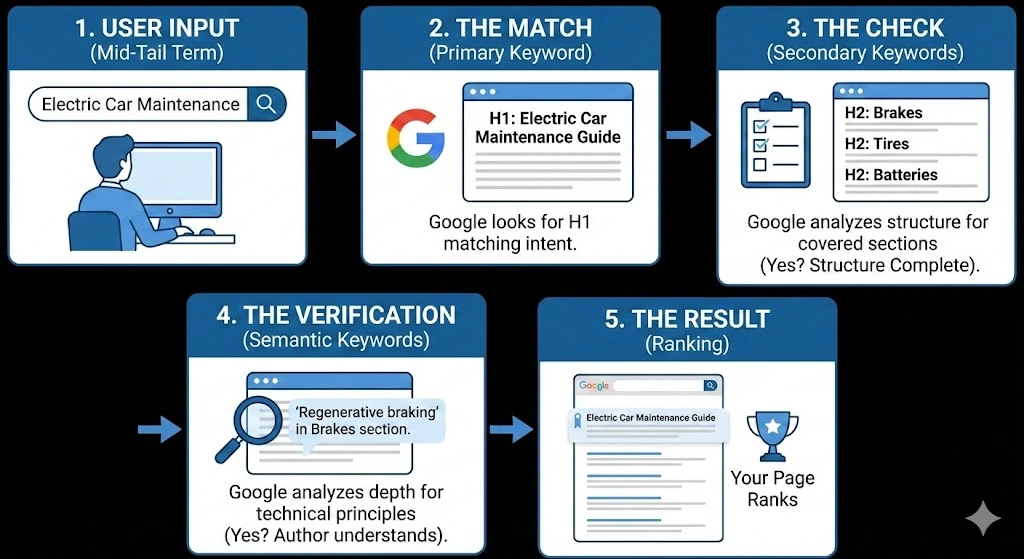
The full keywords Ranking Algorithm from user input to final ranking
1: User Input
A user searches for a Mid-Tail term: “Electric Car Maintenance”
2. The Match (Primary Keyword)
Google looks for a page where the H1 matches the intent: “Electric Car Maintenance Guide”.
3. The Check (Secondary Keywords)
Google analyzes the structure: “Does this page have H2 sections covering ‘Brakes’, ‘Tires’, and ‘Batteries’? Yes? Then the structure is complete.”
4. The Verification (Semantic Keywords)
Google analyzes the depth: “Inside the ‘Brakes’ section, does the author use the term ‘Regenerative braking’? Yes? Then the author understands the technical principles.”
5. The Result
Your page ranks.
Key Takeaways
So, let’s get back to the beginning question: how many types of keywords in SEO?
About Keywords Volume
- Head terms: Shorter, higher volume, vague intent clarity
- Mid-tail : 3-4 words, medium volume, clear intent clarity
- Long-tail: 4+ words, minimum volume, clearest intent
About Search Intent
- Queries containing navigational keywords are looking for specific websites.
- Queries containing informational keywords are looking for educational blogs
- Queries containing commercial investigation keywords are looking for product reviews, comparisons, and more details about products.
- Queries containing Transactional keywords are ready to purchase or convert, and they are looking for product pages or service pages.
About Keywords Roles
- Each page holds one single primary keyword as the main topic
- Multiple secondary keywords act as sub-topics to support each primary keyword
- Semantic keywords need to be curated and synthesised naturally to build authority.
FAQ
Why would a Secondary Keyword (like “tire rotation”) have a higher search volume than my Primary Keyword (“electric car maintenance”)?
It happens because a keyword’s role (Primary vs. Secondary) is determined by the context and hierarchy of your specific article, not just by its search volume.
Some topics are universal. “Tire rotation” is a Head Term on its own because it applies to all cars, leading to a massive search volume and broad intent (Are they looking for a service? A how-to guide? Costs?). In contrast, “electric car maintenance” is a more specific Mid-Tail topic.
You aren’t trying to rank for the massive, broad term “tire rotation.” Instead, your H2 heading would be highly specific, like “Tire Rotation for Electric Vehicles,” which directly supports your main topic and carves out a relevant niche within the broader term.
The key takeaway is this: When building your content’s structure, you must prioritize topical relevance and hierarchy over raw search volume.